Planescape: Torment Review

Planescape: Torment Introduction
Planescape: Torment is an AD&D 2nd Edition cRPG set in TSR's Planescape Campaign Setting (PSCS). In fact, PS:T is the only game set in Planescape and is likely to remain unique in that respect. PS:T was built on BioWare's influential Infinity Engine.
As it pertains to cRPG Design, Planescape: Torment is rated as Above Average.
Planescape: Torment Campaign Setting
Originally created by David "Zeb" Cook, the PSCS has since been fleshed out by several Boxed Sets, adventure modules and accessories. The PSCS is notable for its non-standard gritty aesthetic and language as well as its emphasis on cosmology (Planes and planar travel), powers (gods) and philosophy (ideological factions). Due to those last three, it presents itself as more cerebral than the Forgotten Realms, DragonLance or Dark Sun, which are more about treasure-hunting, wars and survival in a desert wasteland.
Planescape: Torment does a good job of translating the world, powers and factions of the PCSC into a cRPG. While it tells a personal story of an immortal in search of the reason for his immortality, its scope is far-reaching and stretches across the planes...

While PS:T employed the full party control, isometric perspective and round-based combat system common to all IE games, it also broke the mold in its employment of dynamic alignment, in its ruleset implementation, and in its profoundly modified user interface.
In regards to campaign design, PS:T also separated itself from the pack, for good and for bad. Let's take a quick look, shall we?
Planescape: Torment Reactivity
PS:T employs build-based cRPG reactivity as it pertains to stats, alignment, class, quests, factions, tattoos and companions. But what is reactivity?
By "reactivity", we are referring to how the campaign reacts to The Nameless One (TNO) that we have chosen to role-play; for example, the campaign frequently checks TNO's class, stats and abilities along with the decisions made over its course, thereby determining the possibilities and outcomes for TNO and his companions.
To give an example, Mage-class TNOs sporting an Intelligence score >=18 and a Wisdom score >=19 can unlock the Eighth Circle of Zerthimon to upgrade Dak'kon (Str +1, Dex +1, Con +2); the whole Zerthimon dialogue segment (which also nets +12 spell scrolls) being one of the most memorable in cRPG History:

Through other reactive dialogues, TNO can can recall how to raise the dead and how to speak with the dead. The former is especially emotive [Deionarra]. Through his choices, TNO gains access to unique tattoos (items that can be equipped on the paperdoll) which can bestow non-trivial bonuses. He is also able to join factions such as the Dustmen, thereby gaining access to unique items and quests. However, it is disappointing how little impact factional reactivity has on the campaign.
Alignment, on the other hand, has significant impact on the campaign. However, Lawful Good is the most rewarding though also the most difficult to reach and maintain (at least for players who are seduced by entertaining or "jerk" dialogue responses).
The goal of reactivity is to make the player feel like their choices matter and that they are actually role-playing their TNO / are TNO. And a particular incarnation, whether that be Mage or Fighter, Good or Evil, Lawful or Chaotic or somewhere inbetween.
cf. Reactivity Baldur's Gate.
The World of Planescape: Torment
The multi-verse is a big place and it don't play by the "normal rules", whatever they are, but learning the dark of them is the stuff of life. A being's got to become a blood to know all the different ways magic works out on the Great Ring, and no basher should ever be able to just lay his hands on a map of all the portals between the planes. There's things a sod wasn't meant to know and things he's just got to learn by experience. (A body can describe what it's like in the furnaces of Carceri, but it just ain't the same as going there.) Sure, some of the multi-verse is so simple that even a Bariaur basher'd understand, but there's some of it that's real dark, and it's meant to be that way. So folks with no business knowing these things should just keep their noses out of it — understand? — Introduction, PSCS Boxed Set, TSR 2600.

Ruled by the Lady of Pain, Sigil aka the City of Doors constitutes the meat and potatoes of the Planescape: Torment campaign. Similar to Baldur's Gate, Sigil is a quest-dense urban hub encompassing dozens of unique zones, but unlike BioWare's iconic city, its zones are not contiguous in terms of graphics, and so this constitutes a design failure on par with BG2's Athkatla.

Thus, Sigil feels less like a city and more like a cobbling-together of the elements of a city. Moreover, exploration of Sigil and its outskirts is gated by plot-progression rather than being largely free, open and non-linear, as in Baldur's Gate, Fallout and Fallout 2.
To be fair, Sigil is still one of the greatest quest-dense hubs ever designed. And its graphical tone is consistent even without contiguity.
The cRPG dialogue in PS:T is torrential. Words, words, words. It just rains and rains words. Here is a dialog.tlk size comparison:
To be fair, Sigil is still one of the greatest quest-dense hubs ever designed. And its graphical tone is consistent even without contiguity.
Torrential Dialogue in Planescape: Torment
- Baldur's Gate 2 v.26498: 7465 KB
- Planescape: Torment v.1.1: 6393 KB
- Icewind Dale 2 v.2.01: 4605 KB
- Baldur's Gate v.5512: 2987 KB
- Icewind Dale v.1.42: 2798 KB
If it isn't obvious from the version numbers, BG1, BG2 and IWD dialog.tlks include the content added in the expansions (TotSC, ToB and HoW).
And yes, overall, BG2 contains more dialogue than even PS:T, but its emphasis is still not on reading, and a lot of words are confined to optional romances, strongholds and a deeper companion pool (17 vs. 8).
And yes, overall, BG2 contains more dialogue than even PS:T, but its emphasis is still not on reading, and a lot of words are confined to optional romances, strongholds and a deeper companion pool (17 vs. 8).
While most of the dialogue, descriptions of lore and journal entries in PS:T are well-written, the sheer cascading paragraphs and multi-threadedness can be overwhelming for some players, and the writing sometimes becomes annoying with its *emphasis* on certain words, its confrontational tone in general, and its awkward inclusion of Planar cant and jargon.
To be fair, this is the style of writing seen in the above-quoted PSCS Box Set written by David "Zeb" Cook, but I just don't see the point in learning 16th-18th cent. slang in order to get to grips with a CS. To my mind, such modes of speech should be confined to thieves' guilds, gypsies and professional beggars: a particular social strata of society rather than the universal. This is just too geeky for my tastes but others may appreciate it so I'll leave it at that.
To be fair, this is the style of writing seen in the above-quoted PSCS Box Set written by David "Zeb" Cook, but I just don't see the point in learning 16th-18th cent. slang in order to get to grips with a CS. To my mind, such modes of speech should be confined to thieves' guilds, gypsies and professional beggars: a particular social strata of society rather than the universal. This is just too geeky for my tastes but others may appreciate it so I'll leave it at that.
The screencap below depicts the dialogue with one of four Giant Skeletons standing guard in the Mortuary of the Prologue. As you can see, it's well-written but quite lengthy.

And in order to maximize experience point yield and material rewards, we must go through the exact same dialogue four times (one for each skeleton). People often complain about "trashmobs" in cRPGs. Well, PS:T has trashmobs AND trashtext. Moreover, that is actually not an example of a long dialogue segment in PS:T. Wait until we meet up with a certain old crone, called Ravel.

And in order to maximize experience point yield and material rewards, we must go through the exact same dialogue four times (one for each skeleton). People often complain about "trashmobs" in cRPGs. Well, PS:T has trashmobs AND trashtext. Moreover, that is actually not an example of a long dialogue segment in PS:T. Wait until we meet up with a certain old crone, called Ravel.
Buggy Dialogue
There are many situations where, if we choose the "wrong" dialogue option (say, thread "a" before thread "b"), we will just be LOCKED OUT. This can cause us to miss out on quests, powerful bonuses and even entire segments of the game for no apparent reason. Indeed, it can break the campaign and render it incompletable.
In the replay I recently conducted I was locked out no fewer than 10 times. It is incredibly annoying to have to reload the game just because (to give an example), we simply rested in dialogue before requesting a key in that same dialogue — and broke plot progression as a result.
There are dozens of other examples such as Aola (no demon waiting in Curst for us), Narochj (no Dustman faction for us) and Ingress (no Morte teeth upgrade for us). These are the result of QA/play-testing inadequaecy.
In regard to the Norochj bug, we can literally see the thread glitch out and skip. It's a complex interplay between other NPCs in the Gathering Dust bar, including Emoric whose threads alone are complex. It's possible to skip the Not-a-Dustman quest as a result and lock ourselves out of the faction for good, which is a pretty big deal for a Mage TNO who wants access to embalming-based spells that increase tanking ability. And unless we saw the thread jump-skip or have foreknowledge of the correct quest order, we won't know something is amiss. Even a veteran may miss the glitch and return from the lengthy catacombs segment only to find that Emoric has no thread for joining the Dustmen. Your heart will sink if this happens to you.
Also, the multi-threadedness of the dialogue is at times absurd. Getting the proper quest order going in the Dead Nations (with the interplay with the Warrens) is like pulling teeth. It took me three hours to work out how to optimize experience point yield in that segment.
There are dozens of other examples such as Aola (no demon waiting in Curst for us), Narochj (no Dustman faction for us) and Ingress (no Morte teeth upgrade for us). These are the result of QA/play-testing inadequaecy.
In regard to the Norochj bug, we can literally see the thread glitch out and skip. It's a complex interplay between other NPCs in the Gathering Dust bar, including Emoric whose threads alone are complex. It's possible to skip the Not-a-Dustman quest as a result and lock ourselves out of the faction for good, which is a pretty big deal for a Mage TNO who wants access to embalming-based spells that increase tanking ability. And unless we saw the thread jump-skip or have foreknowledge of the correct quest order, we won't know something is amiss. Even a veteran may miss the glitch and return from the lengthy catacombs segment only to find that Emoric has no thread for joining the Dustmen. Your heart will sink if this happens to you.
Also, the multi-threadedness of the dialogue is at times absurd. Getting the proper quest order going in the Dead Nations (with the interplay with the Warrens) is like pulling teeth. It took me three hours to work out how to optimize experience point yield in that segment.
Poor Combat Encounter Design
PS:T combat encounter design is practically non-existent. It is regrettable (since Fallout 1 did a better job of balancing dialogue, questing, exploration and combat) that dev-cycle emphasis on dialogue, lore and writing in general detracted from the effort that should have been put into the most important aspect of an A/D&D campaign.

Furthermore, what combat there is that manages to spark interest in fans of BG and IWD, is ruined by:

Furthermore, what combat there is that manages to spark interest in fans of BG and IWD, is ruined by:
- the abysmal pathing routine (worse than even pre-patch BG1)
- broken inventory mechanics (buff or heal as many times as we like per round; multiple quaffings stack)
- clunky portable pop-up (below-pictured)
- no combat feedback in the dialogue window
- limited spell ranges / special abilities
- lack of buff/negative status effect indicators on the portraits (we won't even know what's going on half of the time)
- absurd Final Fantasy-style cutscenes that trigger scripted and pre-rendered FMVs every time we cast an epic spell
- spell effects that obscure the on-screen action (can't see what is going on!)
- stat-screen doesn't even show adjusted THAC0

Must it be expressed in such simple terms as: I'm not sitting before my PC to read, I'm not sitting before my PC to watch, I'm sitting before my PC to play a computer game. It's called gameplay and it's what makes games games. Go and develop an interactive novel or an adventure game if you want to limit gameplay: you have no business developing for this genre.
PS:T combat is just completely uninspiring and yawn-inducing. Remembering that it was released several months after Tales of the Sword Coast, there are no notable mage duels à la Davaeorn...

... there are no interesting set-piece battles or boss encounters (Warders & Aec'Letec)...

... there are no rival adventuring parties to pit TNO's crew against...

... and there is almost no terrain to be employed by the player for tactical purposes. Instead, combat encounters are usually staged in wide open areas and largely consist of one benign trashmob (that might bleed into an adjacent, identical trashmob), one toughie and his crew, one super-toughie all alone, or just a full-blown horde such as the one in Curst prison: no fewer than 57 hostile Curst Guards.
Is this PS:T or Diablo 1?
Is this PS:T or Diablo 1?

Cool itemization: punch daggers:

Axes:

Cool companions:

Could have meant cool combat, too. But no.
I've criticized the combat in PS:T a lot, and for good reason. The campaign employs a solid combat-centric - indeed, a hack n slash - ruleset (AD&D 2nd Edition), awesome companions and enemies, along with some nice dungeon design and itemization.
And yet, somewhere along the line, Black Isle decided to drown the campaign to death in torrential dialogue and loredumps; to ruin it.
Bravo.
Planescape: Torment is NOT a Passive Game

PS:T should not be given a free pass by members of its fanbase who like to cite it as "an interactive novel with stats thrown in" that should be played "passively"; in other words, the aggro is hot on their heels and mad as hell as they frantically run about the area, all the time hoping that the pathing routine doesn't f**k them over as they seek out the next "quest post" to click on, the location of which is only known to them by virtue of foreknowledge.
These posers love to boast about how we only have to slay four NPCs to get through the game; this does not make PS:T passive by design for the above reason. Fallout can be played by a genuinely passive Vault Dweller, and I have satisfied ToEE's main quest without so much as even drawing aggro. Whoop-de-doo for meta-gaming.
If, through a Strength or Charisma check, one can intimidate or bluff potential aggro into backing down —

— likewise, if, through a Dexterity check, one can stealthily break someone's neck and avoid AR-wide alarm bells...

— then that's great. And we needed more of that. But otherwise the aggro is spawned to be slain, it is in fact easier to navigate an area once the aggro has been cleared (and logical to do so in most cases), and there is a reason for all those weapons, direct damage spells and Morte taunts.
These posers love to boast about how we only have to slay four NPCs to get through the game; this does not make PS:T passive by design for the above reason. Fallout can be played by a genuinely passive Vault Dweller, and I have satisfied ToEE's main quest without so much as even drawing aggro. Whoop-de-doo for meta-gaming.
If, through a Strength or Charisma check, one can intimidate or bluff potential aggro into backing down —

— likewise, if, through a Dexterity check, one can stealthily break someone's neck and avoid AR-wide alarm bells...

— then that's great. And we needed more of that. But otherwise the aggro is spawned to be slain, it is in fact easier to navigate an area once the aggro has been cleared (and logical to do so in most cases), and there is a reason for all those weapons, direct damage spells and Morte taunts.
To be clear, I'm not talking about slaying every trivial respawning Hive Thug; I'm talking about real aggro that is actually a threat, yields solid XP (and potentially powerful and interesting material rewards), and is unavoidable short of playing all kinds of silly positional tricks.
Planescape: Torment Aesthetics
As with the other Infinity Engine games, PS:T was designed and coded to run in a native resolution of 640x480.
[proof: Original Planescape: Torment main menu].

That includes UI panels.
Area, architecture and sprite design along with the color scheme and textures employed separate PS:T from its medieval-fantasy IE cousins. From the dilapidated Hive to the opulence of the Civic Festhall, it's impressive to look at.
Area, architecture and sprite design along with the color scheme and textures employed separate PS:T from its medieval-fantasy IE cousins. From the dilapidated Hive to the opulence of the Civic Festhall, it's impressive to look at.

Sprite size for protagonist, companions and NPCs was notably increased, and extra anim cycles were added (f.e, walk and run cycles). Watching TNO slide off the Mortuary slab and have a floating skull bob over and start chattering to him will be forever etched in my mind.
There are many idle anims, too: nice touches reminiscent of Fallout 1 and Jagged Alliance 2. The anims are not on par with those two but they are certainly a big step up from BG1!
Note the transparency effect for the ethereal Deionarra:

There are many idle anims, too: nice touches reminiscent of Fallout 1 and Jagged Alliance 2. The anims are not on par with those two but they are certainly a big step up from BG1!
Note the transparency effect for the ethereal Deionarra:

Audio-wise, I'm pretty nostalgic for the OST and VOs. I almost shed a tear upon hearing the main menu music for the first time in 10 years, though I wasn't able to call one forth even though I tried pretty hard to do so.
And of course, Deionarra's theme, punctuated by her voice. My views here are incurably colored by nostalgia so that's all I'll say on OST/VOs.

The sound effects, on the other hand, are a bit disappointing in that there are no footstep sounds and no sounds for opening doors and chests (as in the other IE games). There are also no general voiced NPCs, like in BG1, and the ambient chatter isn't enough to cover for that. Thus, sometimes, the game just feels oddly silent and unengaging.
The Power of TNO
TNO Immortality
This godly built-in ability deserves an immediate mention. Basically, The Nameless One or protagonist of Planescape: Torment is an immortal being. When he "dies", he auto-raises at a reset-point and can resume adventuring immediately. There is almost nothing and no one that can permanently kill him; the penalty of death solely consists in the need to reheal and travel back to the scene.
For TNO, death can actually be employed as a means of travel: in the low levels, TNO usually appears back on his slab in the mortuary but in some cases he may travel to places he has not yet been (such as the Trash Warrens). This simulates the reinterment or collection of his corpse by Dustmen or others. Players that learn of the destinations can therefore get themselves killed on purpose in order to travel. Basically, death-travel can save on backtracking or speed up campaign advancement.
TNO Raise Dead Special Ability
Imagine a third level character that can Raise Dead as an innate ability three times per adventure interval? This extraordinary latent ability is acquired from a regained memory while speaking to Deionarra in the Mortuary Prologue, but is entirely missable. If it is missed, TNO's companions can only be raised in combat zones by Fall-From-Grace once she breaks into fifth circle divine spells at 9th level or 225,000 XP. And we all know how many hoops we need to jump through in order to find Grace, recruit her, and level her to that point.


TNO Regeneration
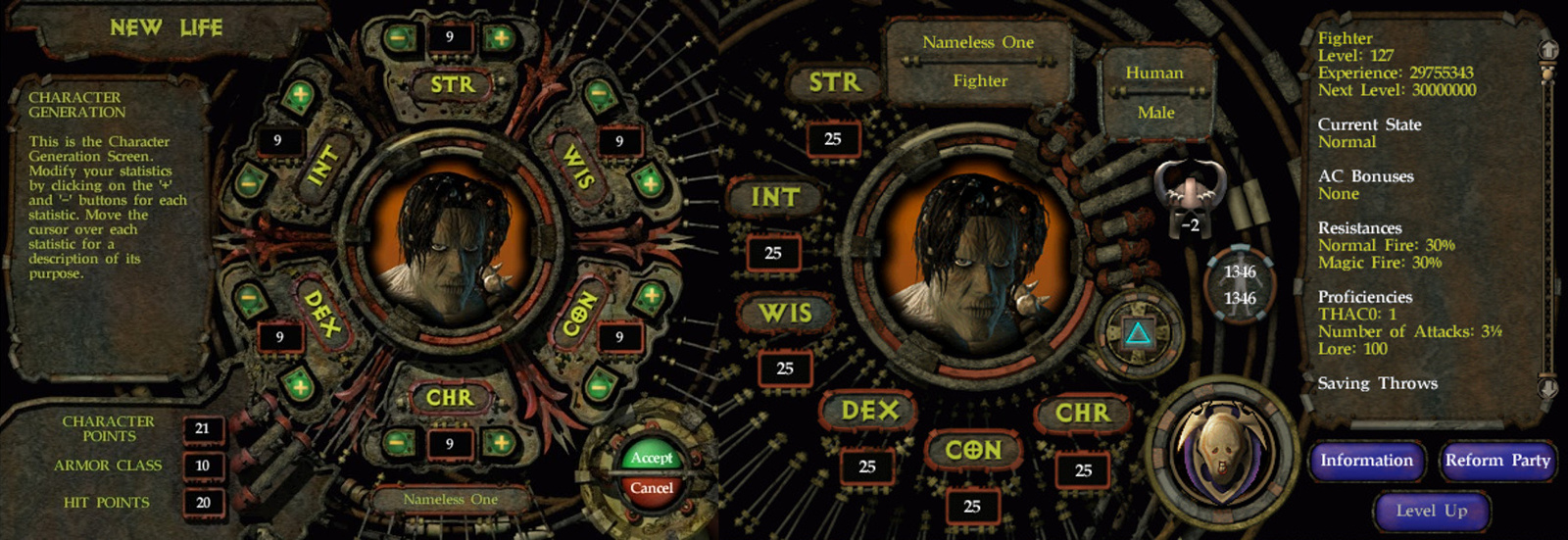
TNO sports regen at even the lowest Constitution scores; the rate of regen increasing as the score is cranked on level-ups (or through tattoos and other items, but that is not innate). TNO regenerates 1 HP every other round at Con 18 (as low as third character level; that is, chargen) and maxes out a whopping 12 HPs per round at Con 25 (as low as ninth level), which is four times the rate of a troll and almost twice that of a Solar. In comparison, entry-level regen is possible in Baldur's Gate, but only for Kagain BG1 and Charname BG1 Dwarves: 1 HP every 60 rounds.
Note that Dak'kon and Morte can attain solid healing-rate regen, but only through items.
Note that Dak'kon and Morte can attain solid healing-rate regen, but only through items.
TNO Stats
TNO can hit scores of 25 in Strength, Constitution and Wisdom by 12th level. He can also achieve 3½ ApR by 13th.
Best Phase of Planescape: Torment
Consisting not only of the Dead Nations, Drowned Nations and the Warrens of Thought, but also of caves, crypts and the Tomb of TNO, the Catacombs of Planescape: Torment stand as one of the most atmospheric cRPG dungeons in the genre. The previous non-linear exploration of the quest-dense urban hub of Sigil is also a standout, and feeds into what we see below.

This is the highlight of the campaign; mystery is at its highpoint and it's dangerous adventuring. Love it.
But after those two phases, the campaign is comparatively poor (Sigil: Lower Ward & Clerk's Ward), and turns out to be a major disappointment (Curst, Baator, Carceri) [Planescape: Torment world map].


Final Judgment
To conclude this review, PS:T was made too early in the Infinity Engine life-cycle, and it shows. Constituting a branch of development all of its own -- and that during the engine's infancy -- it could not avail of any engine extensions or refinements made by BG2 and IWD2, but it did manage to influence subsequent IE games and future cRPGs, for good and for bad.
PS:T is deeply flawed similar to Troika's unpolished and bug-ridden masterpieces [ToEE, Arcanum], but the latter are superior as games. And while Troika's cRPGs are underrated, PS:T is somewhat overrated.
Bearing in mind that it would not have existed without its spiritual predecessor, Mask of the Betrayer arguably knocked PS:T from its perch in regard to cRPG reactivity and cRPG story. MotB is also much more replayable by virtue of its D&D 3rd Edition cRPG ruleset, its largely non-linear campaign, its spirit-eater mechanic that facilitates resource management, and its mutually exclusive companions deeply embedded into the lore, quests and plot.
We are unlikely to want to endure PS:T more than a few times thanks to its torrential dialogue, linear final quarter and painfully limited build options.
Best Build Planescape: Torment
As hinted at in the manual itself, there is a singular TNO build that offers the best overall experience and access to the most content; that is, the best build in Planescape: Torment is a Lawful Good Mage TNO with maxed Intelligence, maxed Wisdom and minor investment in Dexterity and Charisma (buffed with Friends).
If such TNOs take Fighter to 13th level, then they will also have tons of HPs, ApR 3.5 and Grandmastery -- even when they switch back to Mage.
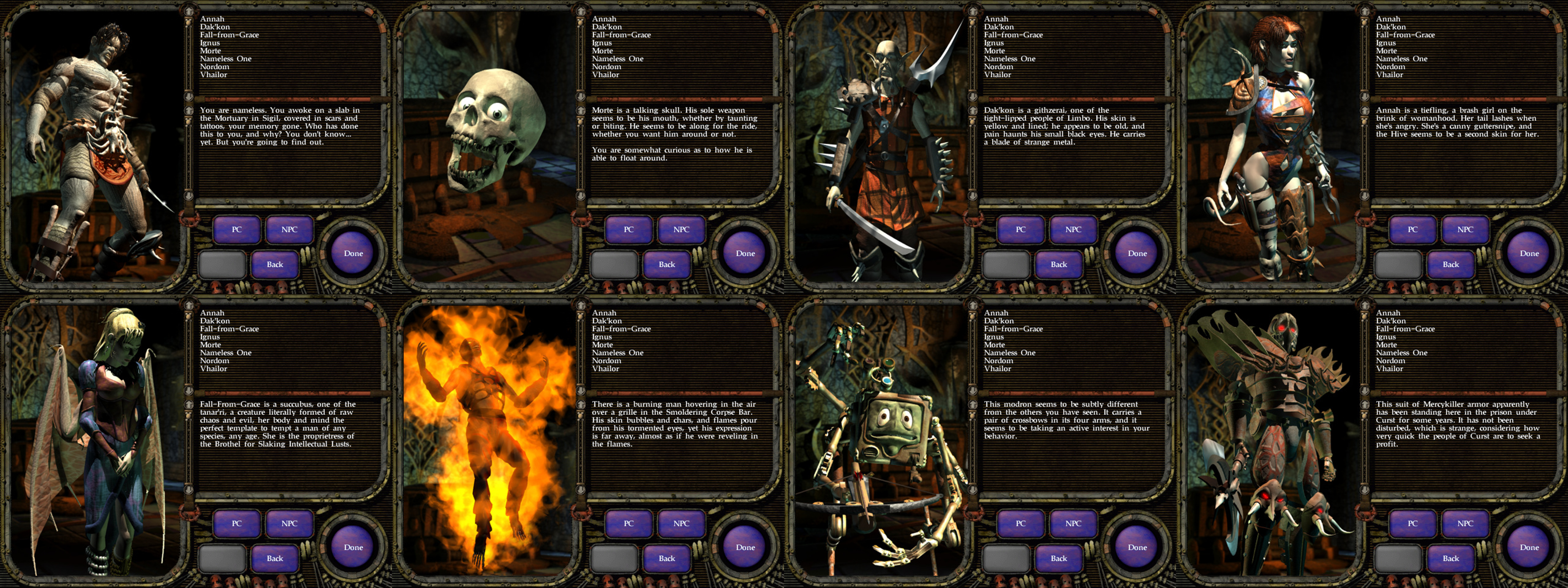
Not only that, but party composition is pretty much set in stone: it consists of Morte, Dak'kon, Annah and Grace, first and foremost. Then, Ignus and Vhailor are milked for all their worth, and Nordom usually becomes the final addition to the six-person party. Therein lies the core experience — and it's a good one.
Not only that, but party composition is pretty much set in stone: it consists of Morte, Dak'kon, Annah and Grace, first and foremost. Then, Ignus and Vhailor are milked for all their worth, and Nordom usually becomes the final addition to the six-person party. Therein lies the core experience — and it's a good one.
I've criticized PS:T a lot in this retrospective, but I acknowledge that, as a cRPG, it is still head and shoulders above the current gen crop of crap. Note also that Planescape: Torment is ranked in Best cRPGs.
Planescape: Torment System Requirements
Planescape: Torment requires a Pentium 200 MHz MMX CPU, 32 megs of RAM, 8-speed CD-ROM drive and 650 megs of hard disk space. In addition, Planescape: Torment requires a DirectX-compliant sound card and a DirectX-compliant video card with 4 megs of vRAM. OS-wise, Planescape: Torment requires Windows 95, 98, Me, 2000 or XP. Planescape: Torment does not utilize Direct3D or OpenGL.


Planescape: Torment Guide

Welcome to my guide for Planescape: Torment, a cRPG of 1999 developed by Black Isle Studios. The following tips are based on the meat & potatoes portion of Planescape: Torment; namely, once TNO has recruited a full party in the Lower Ward and gets access to the Modron Maze and Under Sigil, both of which challenge tanking and DPS effectiveness (High Threat Constructs and Larval Worms). I'm not counting late-game Vhailor outside of the ApR section.
This post is divided into two sections:
- Tanking (AC, DR, HPs, Regen)
- Damage (THAC0, ApR, Str bonus, itemization)
Planescape: Torment Tanking
From my Baldur's Gate review: The purpose of tanks is to attract the aggro and then absorb or mitigate damage so that squishy party members are free to cast spells and fire projectiles from the back row. Attracting the aggro is usually a fairly simple matter: just ensure the tank is the first party member of which the enemy catches sight; blinded by hatred, they will then charge forth and futilely wail on the tank, foolishly ignoring the mages and archers who are picking them apart from safe distance. The most effective tanks - who can also melee with the best of 'em - are quite clearly Fighter/Mages; their extremely low ACs (-20s) and access to Mirror Image allowing them to mitigate damage against the most formidable fighters known to Realmslore such as Sarevok and Drizzt Do'Urden.
Planescape: Torment is exactly the same except that the party does not have access to as many absorption sources, and does not have access to mitigation on par with the Best Baldur's Gate spells such as Mirror Image, Stoneskin or Protection From Magical Weapons. PS:T Cloak of Warding is just a joke in comparison (soaks 3-12 dmg +1 per caster level).
Planescape: Torment Armor Class (AC)
AC stands for Armor Class. Unlike in the other Infinity Engine games (in which — with the notable exception of Throne of Bhaal — nigh-unhittable ACs are possible), neither TNO nor companions can reach lordly ACs. Primarily, this is due to the lack of Full Plate Mail and Shield itemization (which is HUGE), but there are also no powerful abilities that allow one to hit the AC cap, such as Bard Song, Blade Defensive Spin and Thief Use Any Item.
In fact, neither TNO nor his companions can even reach BG/1IWD levels of AC. Take for example Dak'kon:
- Base AC 10 (AC 10)
- 18 Dex +4 (AC 6)
- Dak'kon's Zerth Armor +5 (AC 1)
- Dak'kon's Chained Blade: 10th level bonus +6 (AC -5)
- Tattoo of Warding +1 (AC -6)
- Tattoo of Greater Warding +2 (AC -8)
- Displacer Ring +2 (AC -10)
- Mempa's Biting Ring +2 (AC -12)
Annah:
- Base AC 10 (AC 10)
- 18 Dex +4 (AC 6)
- Jerkin of the Brazen Rogue +6 (AC 0)
- Punch Daggers of Zar'Anun +2 (AC- 2) (Spiked Gauntlets of Ogre Power are more damaging but give no AC bonus. However, they should definitely be wielded and therefore Annah won't have this bonus from the Lower Ward onwards.)
- Tattoo of Warding +1 (AC -3)
- Tattoo of Greater Warding +2 (AC -5)
- Displacer Ring +2 (AC -7)
- Mempa's Biting Ring +2 (AC -9)
- Stinger Earring +2 (AC -11) (The effects of two don't stack.)
You can also factor in armor modifiers to specific damage types from both armor and items. Cockroach Charms bestow +4 AC but will not stack beyond -10 AC total for character.
Fighter TNO Armor Class
Armorless and unable to wear the Magus Shield (AC 4), Fighter TNO needs to be buffed by Dak'kon with Armor (AC 6) or Shield (AC 3). It is highly unlikely that a player would crank TNO Dex to 24 just for an AC adjustment of -6 (and there is no other reason so to do), so I'm not going to go further with this. Suffice it to say that TNO isn't about AC; rather, his great tanking ability stems from HPs and regen (see below).
Taking into account buffing in addition, AC doesn't drop much lower. First of all, the effects of Blur, Submerge the Will and Shroud of Shadows don't stack (+2 AC each) but Blur will stack with Greater Embalming for +4 to AC. Problem is, only TNO and Morte can be buffed by undead-only GE. Luck probably adds +1, too.
But that is still about 5 points shy of what two conventional warriors can reach in BG and IWD (and BG Fighter/Mage dual- or multi-classes can reach about -20). Plus, PS:T encounter design isn't always trivial: consider hard hitters such as Larval Worms, Baatezu/Tanar'ri (Abishai, Glabrezu, Cornugon), High Threat Constructs, Harmonium hard-heads and Curst Prison Guards. Moreover, some of the items for Dak'kon and Annah — not to mention TNO — overlap, and there are no notable duplicates to be found (though there are two Displacer Rings). Thus, it is impossible to have three AC lords: you will only have about 1½ — if you're thorough and know the itemization well.
tl;dr: You are going to get hit, and often. You will need to rely on Morte damage resistance, TNO regen, Grace clerical healing, immobilization spells and sheer damage output if you're going to survive tough mobs in Under Sigil and full-blown hordes in Carceri and Baator. Relying on AC alone, the party will be ripped a new one in short order. AC just doesn't cut the mustard like it does in BG1 and IWD1.
Hit Points & Regeneration (HPs & Regen)
Fighter TNO is the King of HPs and regen. Assuming max HPs on level up and Con 25, a 20th level TNO patched with Warrior/Supreme Warrior will sport a deep pool of 270 Hit Points (300 embalmed) along with regen that probably exceeds any creature on the Infinity Engine, including trolls and greater werewolves. Thus, TNO's regen will offset damage taken against a pack of Hive thugs, but one Black Abishai will eventually wear him down with its non-trivial dmg and attack rate.
Also, single 8 hour rests or simple area transitions heal TNO completely (TNO has no need for Grace's clerical healing). Dak'kon and Morte are about equal second in HPs but only Dak'kon can reach Con 20 which grants humble Kagain-rate regen. This will require the Tattoo of Greater Health and the completion of the Zerthimon circles (for which TNO must be Mage/switch to Mage and requires Int 18 and Wis 19). However, its rate is useless in combat and only good for area transition-healing and rest-healing (which is still a very convenient perk).
So here we have Morte with a THAC0 of 4½ ApR (EED) and Teeth of the Fire Drake trying to take down a Greater Embalmed Mage TNO with 25 Con regen and AC -1.
Planescape: Torment Damage Resistance (DR)
By virtue of the Spider Bracelet purchasable in the Clerk's Ward, Annah and Thief TNO can get 25% resistance to all forms of non-enchanted physical-based damage, but that doesn't compare to Morte who boasts 75% DR vs. unenchanted or enchanted slashing, piercing or crushing damage. In this vid Morte far outlasts Dak'kon and Annah against a Str 25 TNO wielding the Hammer of Comminution at 3.5 ApR.
Clot Charms
Clot Charms are easily farmable random drops that bestow 5% resistance to slashing and 10% to piercing. The effects of multiple quaffings will also stack to 100% and above. Thus, if Morte quaffs enough of them then slashing and piercing attacks will not damage him no matter the enchantment level of the weapon. But, unlike BG2, he will not be healed with resistances greater than 100% (it is possible to be healed by bludgeoning dmg in ToB).
Planescape: Torment Damage
THAC0. To Hit Armor Class Zero caps out at 1 for all Fighters and multi-classed Fighters. I mention that because to-hit factors into DpR since it determines whether or not you hit in the first place. That's all I'll say about THAC0 because it's a natural progression and you never feel like you have to buff it (mainly because no enemy is an AC lord and Fighter TNO and companions have decent Strength or Dex).
Planescape: Torment Attacks Per Round (ApR)
From my Icewind Dale Review:
ApR is the number of attacks a character can perform in a given round of combat (i.e, attack rate). It is an especially important stat in a campaign that reduces the viability of direct-damage spellcasting and features waves and waves of enemies susceptible to physical-based damage. In addition, many itemized weapons inflict chance-based on-hit negative status effects such as stun, fireball, disease — and even effects akin to vorpal — so, it stands to reason that the more often you can attack, the more often these devastating effects are going to trigger. Three melee units attacking at a rate of 5 ApR, and inflicting stun on a regular basis, is just TOO good.
Except for the max ApR and on-hit effects (there are a few in PS:T but not to the degree of IWD), the above is true for PS:T, too.
ApR Sources for BG, IWD and PS:T:
- Base ApR: 1 (1 ApR)
- Specialization (available at Warrior 1st lvl): +½ (1 ½ ApR)
- Grandmastery (available at Fighter 9th lvl): +1 (2 ½ ApR)
- Warrior class 7th lvl bonus: +½ (3 ApR)
- Warrior class 13th lvl bonus: +½ (3 ½ ApR)
- Iems/Spells (+ApR weapons/Haste-Improved Haste-Enoll Eva's Duplication)
ApR is king in BG and IWD, and PS:T is no different. Well, not all that different:
Fighter TNO, Morte, Dak'kon, Annah, Nordom and Vhailor get 1 base attack and +½ attack at 7th and 13th Fighter levels. This is as per AD&D 2nd Edition rules and as per BG, BG2 and IWD.
Next, everyone can reach and everyone gets +½ ApR for Specialization (that is, two proficiency points in a weapon grouping). TNO must get this from Porphiron in the Hive.
Thus, everyone can attain 2½ ApR.
However, only Fighter TNO, Morte, Nordom and Vhailor can achieve Grandmastery for a full +1 ApR (that is, five proficiency points in a weapon grouping). 12th level TNO can get GM from Korur as soon as he enters the Lower Ward (or Marquez in Curst post-Ravel.)
Dak'kon and Annah only get High Mastery; thus, they max out at natural 2½ ApR. Note that multi-classed characters should only be able to Specialize, anyway.
Morte gets Grandmastery at 11th level
Morte is favored in that he actually gets GM in "fists" at 11th level whereas TNO and Vhailor must wait until 12th, by the rules. Nordom must wait until 13th for GM (thus, he jumps 1½ ApR when he reaches 13th).
So yeah, at Fighter 13th, TNO, Morte, Nordom and Vhailor max out at 3½ ApR whereas Dak'kon and Annah are stuck at 2½ ApR. Note that Enoll Eva's Duplication with add +1 ApR for a maximum of 4½ ApR.
Nordom crossbow attacks at 4½ ApR:
Note the pathetic range of his crossbow, though; how he has to "step in" just to target TNO who is but a few paces away. Black Isle made a mistake by giving the only "archer" in the game such a myopic range. Disgusting! :P
25 Strength
Now we must take into account the Strength stat which modifies dmg (and to-hit).
Of course, it's all about 25 Strength for that delicious +7 THAC0 and +14 dmg bonus. Fighter TNO can reach Str 25, (and Con 25 and Wis 25) by 12th level, when he also achieves grandmastery. He will then get his 13th level ApR bonus for 3½ ApR (4½ ApR buffed with EED). He also gets to wield the Hammer of Comminution at this point (which is the Lower Ward). This is... insane. Make no mistake, when it comes to pure killin' power, Fighter TNO is a force on the planes...
So yeah, Fighter TNO can easily reach 25 Strength thanks to 7th and 12th level Specialization along with Tattoo of the Supreme Warrior (get it from Fell after 12th Specialization). Morte, Dak'kon, Annah and Nordom, however, must be buffed with Improved Strength in order to get 25 Str (+14 dmg). Unlike Friends, Improved Strength does not stack with itself so you will need to recast it to get a good 1d8+4 roll. Engine reports Nordom gets +20 dmg for 25 str, but this is not reflected in testing. Strength buffs do nothing for Nordom because he wields a crossbow.
OTOH, Zerthimon's Focus notably increases crit-chance for everyone (I suspect +10%). You cannot get ZF unless TNO switches to Mage for the Zerthimon dialogue with Dak'kon (plus you need Int 18 and Wis 19).
Planescape: Torment Itemization
Then, we must take into account itemization and weapons wieldable.
With the exception of teeth and swords, Fighter TNO wields whatever he likes. That includes hammers, edged, clubs, axes and punch daggers. Badass.
Brimstone Sledgehammer
If you go hammers then TNO can get the Brimstone sledge literally straight of the blocks. Just go to the Ruined Cathedral in the Alley of Dangerous Angles and become a disciple of Aoska through Aola. You will be mazed by the Lady of Pain. Now, in the northeast of the maze you will find that hammer (+1 enchantment, 2-9 dmg, +5 fire dmg).
Upgrade to the Hammer of Comminution once you reach the Clerk's Ward, and it's all over. (With the exception that you will have to switch to Hatred's Gift or Heartgrinder axes to take on crushing-immunes in Baator.)
Dak'kon's Chained Blade
Usually Dak'kon wields the Chained Blade +3 to inflict 5-20 dmg assuming he's been conditioned for high morale. Epic. Here is Dak'kon with 3.5 ApR buffed with EED and Zerthimon's Focus. Total Crit Machine.
Btw, his Strength is only 18 there. Best damage-dealer after Fighter TNO.
- Dak'kon's Zerth Blade "Chained Blade" (Edged, PS:T). THAC0 +1, 2-9 slashing, +1 AC (Fighter Level 3).
- Fighter 7: 3-12 slashing, +4 AC, THAC0 +2, Enchanted +2, +2 first circle spells slots, +1 second circle spell slot.
- Fighter 10: 5-20 slashing, +6 AC, THAC0 +3, Enchanted +3, Doubles first and second circle spell slots.
On the githzerai's home plane of Limbo, solid matter is something of a rarity. Limbo itself is a soupy mass of elements, and only through force of will can the githzerai shape these elements into stable matter. A substance called "karach" is a material that can be shaped with the mind. Dak'kon's blade is composed of this substance; through mental discipline alone, Dak'kon maintains the integrity of the blade. He can shape it slightly depending on his skill, adjusting its length, sharpness of the edge. Presumably as he gains levels, he may be able to manipulate the blade in new ways. It is not known whether all githzerai zerth carry such weapons. Certainly a weapon that depends on the integrity of the wielder would be entrusted only to those who had learned to discipline themselves. This blade appears to have special religious significance for Dak'kon. Dak'kon has wound a series of parchments around the hilt of the blade. These appear to be mantras dedicated to Zerthimon.
A weapon that scales handsomely with its wielder's level and morale. Doesn't get much better than that. Amazing weapon that will slay almost everything up to and including Greater Glabrezu.
Annah: Punch Daggers
Annah gets a good variety of punch daggers.
Remember that Annah gains access to a five-point backstab multiplier. Short of abuse, it is underwhelming (about 70-80 dmg in this treatment range). Buff with Zerthimon's Focus to increase chance of crit.
Morte: Teeth
Morte gets sets of teeth (fist proficiency)! Notable progression is:
- Ingress' Teeth (+1 enchantment, 1-6 crushing, +1 crushing [or piercing]; Candrian, Smouldering Corpse Bar, Hive Southeast)
- Teeth of the Viper (+1 enchantment, 2-7 piercing, inflicts poison, Immunity: poison; Marta the Seamstress, Buried Village)
- Teeth of the Fire Drake (+1 enchantment, 1-6 slashing, 3-8 fire, Immunity: fire; Vrischika's Curiosity Shoppe, Clerk's Ward).
Morte should keep his teeth collection ready for switching so that he can inflict the three main forms of physical-based damage.
Ingress' Teeth scale to Morte's level (you will need to "talk" with the teeth). At twelfth level: Enchantment +3, THAC0 +3, 1-6 crushing, +3 crushing, on-hit temporary paralysis). The on-hit paralysis triggers often and against almost any enemy, including baatezu. The effects of paralysis don't last long but that doesn't matter because it will likely retrigger on the next couple of hits, anyway (Morte gets 4.5 ApR with EED).
Nordom: Lenses & Bolts
Nordom is all about Lenses and Bolts (targeting + ammo). He wields a Mechanus Crossbow. Most people will only find the Lens of Inherent Viciousness (+2 THAC0, +2 dmg; Clerk's Ward), but there are two notable random drops in the Modron Maze:
- Lens of Seeing Double (+8 dmg)
- Optix (+2 dmg, +15% crit chance, +1 Luck).
Nordom gets his bolts from Coaxmetal in the Siege Tower of the Lower Ward:
- "Rule-of-Three" Bolts (6-15 piercing, splits into 3)
- Bolts of Acheron (2-5 crushing, on-hit stun)
- Acidic Sponge Bolts (1-2 dmg +6 acid)
- Zephyr Bolts (2-5 piercing)
- Jagged Bolts (3-6 piercing)
- Bolts of Whistling Doom (+2 enchantment, 4-16 crushing, THAC0 +2, Crumplepunch the Blacksmith in Curst)
Once optimized, expect max dmg in the ballpark of 35 or 70 on a "maximally efficient strike" (a crit).
Lens of Double Seeing + Zerthimon's Focus + Rule-of-Three ammo:
Optix + Zerthimon's Focus + default ammo:
So basically, Morte is the best tank, Dak'kon is the second-best physical-based damage dealer despite failing in ApR (after Fighter TNO), and Morte, Nordom and Fighter TNO have the highest attack rate (3½ ApR or 4½ ApR EED'd). As TNO (Fighter, Thief or Mage), if I had to choose just one companion to bring along for combat purposes, it would be Dak'kon for his well-roundedness; he just offers so much.
I'll probably add late-game Vhailor in the future.
Nameless One Maximum Level
The maximum level attainable by The Nameless One is 127. That is the level cap in Planescape: Torment.

The Planescape: Torment XP cap is 999,999,999. All we get from going higher is more HPs.
Companions level cap is also 127.
BG2's level cap is 40.
Planescape: Torment: Best Axes
Due to its AC bonus, on-hit fire damage and massive raw damage, the best axe in Planescape: Torment is Celestial Fire.
Ascension
(AXASC, two-handed axe, PS:T): THAC0 +2, 3-10 slashing, +2 slashing, Cha +1, AC +1.
"Ascension" is one of the finest weapons created at the Great Foundry, the home of the Believers of the Source. It is one of three weapons called the "Triad of Tests", including the hammer "Reason" and the dagger "Enlightenment". The symbol of the faction is engraved on the axe head, and the edges of the blades are so sharp they could split a hair lengthwise. You are the first to bear this weapon.
You will need to join the Godsmen faction in order to net this beast.
Butcherer of Innocents
(BUTCHER, two-handed axe, PS:T): THAC0 +2, Enchanted +2, 3-10 slashing, +2 slashing, on-hit HP drain/transfer to wielder.
This giant, axe-like cleaver earned its nickname while in the hands of Oswell Breck, a butcher who once serviced the Clerk's Ward of Sigil. The chant is that one day this affable and well-respected citizen suddenly went on a murderous and bloody rampage that lasted ten days and ten nights. Cleaver in hand, Oswell stalked the streets of the ward, brutally hacking down every man, woman, and child unlucky enough to cross his path until the Lady herself intervened. It is rumored that he suffered from a strange disease that slowly caused his body to waste away, and it was this disease that eroded his sanity and prompted the murder spree. The origin of this instrument of carnage is shrouded in mystery. However, the various wizards and scholars who examined the discarded weapon after Oswell's mazing have catalogued the nature of its enchantment. The cleaver seems to feed upon its victims, sucking the very life force from them and bestowing a portion of it upon its wielder.
Purchased from Coaxmetal in the Siege Tower of the Lower Ward. Good for extra survival in conjunction with TNO regen.
Hatred's Gift
(HATEGIFT, two-handed axe, PS:T): THAC0 +1, 3-13 slashing, cursed (Berserk).
It is not exactly clear in the annals of known planar history when "Hatred's Gift" was created, but by the bloody trail it has left across the planes seems to have finally reached you. The axe exists to inspire hatred in one's enemies and fill its wielder with a berserker rage. When entering combat, the skulls along the shaft come alive, chittering their teeth, and the teeth (remnants of fiendish victims absorbed into the axe blade) extend outwards, biting and tearing into opponents with each strike. Once equipped, "Hatred's Gift" cannot be dropped unless its curse is removed.
Berserk is bad.
Heartgrinder
(GRINDER, two-handed axe, PS:T): THAC0 +2, Enchanted +1, 3-10 slashing, 1-6 electrical, additional damage against creatures with hearts.
A single teardrop of the wielder's blood, applied at the border where the axe meets the handle, is sufficient to awaken "Heartgrinder." Once applied, the drop of blood freckles across the blade and handle, giving it a dull red radiance. The glow from Heartgrinder pulses, matching the heartbeat of its wielder. No matter what the target, Heartgrinder is a powerful weapon, capable of tearing through nearly any defenses. Against targets with blood running in their veins (whether their own or another's -- vampires beware), Heartgrinder inflicts additional damage, as every stroke also smashes the target's heart, no matter what location the axe struck.
Obtained in Curst after freeing a demon. A nice upgrade once TNO hits Curst.
Entropic Blade
(EAXE, two-handed axe, PS:T: THAC0 +2, Enchanted +2, 3-23 slashing.
This strange item was in your possession after you gave the Modron Cube to the iron golem in the Siege Tower. It looks to be a small dagger, but its surface twists and bends as you watch, as if struggling to break free from its shape. It looks to be made of iron, silver, and any of a number of different metals. Sometimes they blend together, other times, they submerge into the core of the blade, only to resurface again minutes later.
Celestial Fire is superior to the Entropic Blade. The Entropic Blade is a nice fallback for players who weren't disciplined enough to role-play Lawful Good TNO, though (it's not easy for newbies because there are lots of funny dialogue options for them to be seduced by).
Axe of Celestial Fire
(CELESTIA, two-handed axe, PS:T): THAC0 +2, Enchanted +3, 3-18 slashing, +10 fire, AC +2, +10% slashing resistance, LG Fighter only.
The blade of Trias became a heavy axe in your hands. It is warm to the touch, and flames have been carved across the surface of the head. The intricacy of the carvings is breathtaking; they are done with such skill that the axe seems to be burning with metallic flames...someone must have spent several centuries rendering them. The axe looks several millennia old. A faint hum can be felt within it, and the vibration becomes stronger when it touches human flesh.
Now that's what I'm talking about. Very nice damage, thar.
Final Judgment: Executioner's Axe
(two-handed axe, PS:T): THAC0 +3, Enchanted +2, 5-15 slashing, 1-6 fire, double damage vs. the guilty and the Chaotic, Vhailor only, cursed.
This archaic double-bladed battle-axe is reminiscent of an executioner's axe; the axe head has been forged into the symbol of the Mercykiller Faction (a red dragon with its wings outspread...the outstretched wings have been shaped into the blades of the axe). The axe itself is huge; even wielded two-handed, it would require tremendous strength to use effectively. For a spectral entity, Vhailor must be extremely strong. This axe is as much a part of Vhailor as his armor, and the axe itself carries part of Vhailor's essence within it. As a result, it is utterly devoted to justice and will not allow the user to rest while "judgments" are left to be delivered. The considerable damage it causes to an opponent is doubled if the axe strikes a guilty or chaotic creature. Furthermore, the axe itself lends some of its strength to the wielder, giving him added protection from attacks. The origin of this axe is unknown. If you were to hazard a guess, the axe gained its powers simply from Vhailor's belief. If he were to die a second death, you don't know what would happen to it.
This is Vhailor's mighty weapon (Curst Prison). BADASS.
Planescape: Torment Best Punch Daggers
In Planescape: Torment punch daggers, gauntlets and knuckles dusters fall under the fist weapon proficiency.
Morte's teeth and other special weapons are also considered fists, but I'm not concered with them in this write-up. Punch daggers, gauntlets and knuckles are only wieldable by Annah and The Nameless One (TNO).
Fist weapons are class-specific, some are character-specific, and at least one is faction-specific. They are light, backstab-capable and usually inflict piercing damage (though they cover all damage types); also enabling us to attack within the first three segments of a combat round (speed factor). Most commonly, they buff Dexterity, AC and Thief skills.
For TNO, fists constitute one of the best weapon proficiencies due to +itemization instances and variety.
Here are the most notable of itemized punch daggers in the general order of acquisition:
Punch Daggers of Moorin
Enchantment +2, THAC0 +1, 2-8 piercing, +1 piercing, Speed 2, AC +2, Luck +1, Fighter & Thief only; Shattered Crypt, Catacombs, MOOPUNCH.
The Punch Daggers of Moorin are the best punch daggers in Planescape: Torment because they can be wielded by Annah or TNO and by Fighter or Thief; and also because of their early acquisition and long-lasting usefulness (decent stats). The AC bonus is valuable and the Luck buff is non-trivial in PS:T.
Punch Daggers of True Death
Enchantment +1, THAC0 +?, 1-4 piercing, Speed 2, On-hit poison, Fighter & Thief only, Dustmen only, TPUNCH.
Only available to TNOs who have joined the Dustmen faction, post-Catacombs. Sold by Emoric. Enchantment +1 means we can't hit even Abishai. Inflicts 5 points of poison damage per round on a failed save (stackable).
Punch Daggers of Zar'Anun
Enchantment +2, THAC0 +1, 2-12 piercing, +2 piercing, Speed 2, AC +2, Stealth +35, Fighter & Thief only; Lenny, Lower Ward, ZPUNCH.
These constitute a nice incremental upgrade over Moorin.
Punch Daggers of Shar
Enchantment +3, THAC0 +?, 1-4 piercing, Speed 2, Saving Throws +2, Magic Resistance +35%, Fighter & Thief only; Coaxmetal, Siege Tower, Lower Ward, SPUNCH.
Due to the +MR and +saves, these are the situational mage-killer fists.
Spiked Gauntlets of Ogre Power
Enchantment +1, THAC0 +3, 4-6 crushing, 4-6 piercing, Speed 1, Fighter & Thief only; Coaxmetal, Siege Tower, Lower Ward, OGRGAUNT.
Solid damage. Arguably the second best fist weapon.
Umei Kaihen
Enchantment +3, THAC0 +3, 3-21 piercing, Speed 2, Dex +3, +10% Thief Skills, Fighter & Thief only; Under Sigil Greater Glabrezu random drop, UMEI.
Excellent stats but very difficult to farm.
Assassin's Knuckles
Enchantment +3, THAC0 +3, 1-10 piercing, Speed 1, on-hit Stun, Silence, Poison, TNO only, Thief only; Crumplepunch the Blacksmith, Curst, IRON3.
TNO Thief only. These do not inflict Stun. They only inflict on-hit Confusion, on-hit Silence and 10 points of poison damage per round (stackable).
Mark of the Savant
Enchantment +4, THAC0 +3, 3-18 piercing, Speed 2, AC +2, Dex +1, HPs +15, Open Lock & Stealth +25%, Detect Trap +10, Thief only; found just before confronting Trias, SAVANT.
The enchantment is only +3, not +4. Foiled again.
Siphon Knuckles
Enchantment +2, THAC0 +2, 1-6 piercing, Speed 1, on-hit hit Hitpoint transfer aka Larloch, Fighter & Thief only, IRON2.
The Larloch is 1d6.
Entropic Blade
Enchantment +2, THAC0 +2, 3-23 slashing, Speed 1, Fighter & Thief only, Post-Modron Maze; give the Cube to Coaxmetal in the Siege Tower of the Lower Ward, EFIST.
A nice fallback on Celestial Fire for TNOs who weren't disciplined enough to attain Lawful Good alignment.
Gauntlets of Celestial Fire
Enchantment +3, THAC0 +2, AC +2, 3-18 crushing, Speed 3, Fire +10, crushing resistance +10, Fighter & Thief only, Lawful Good only, CFFIST.
The most damaging fist weapon on enemies not immue to fire, but with strict alignment requirements.
- Expected damage for TNO:
- Entropic Blade-fist: 3-23 +3 (6-26)
- Strength 25 (as early as 10th level): +14 (28-40)
- Grandmastery (as early as 13th level): +5 (33-45)
- Crit: 66-90
- Max backstab (x5): 169 (crit: 338)
- Max ApR: 4½ (3.5 innate + EED)
Next up: Icewind Dale 2 Review.
| cRPG Blog | Baldur's Gate 1 | Icewind Dale 1 |
| Neverwinter Nights 1 | Baldur's Gate 2 | Icewind Dale 2 |
| Neverwinter Nights 2 | Baldur's Gate 3 | Planescape: Torment |