This article on Baldur's Gate 1 reactivity is divided into five sections:
- [§1.0] Choice-based Reactivity (Bandit Camp)
- [§2.0] Reputational Reactivity
- [§3.0] Reaction-based Reactivity
- [§4.0] Factional Rivalry
- [§5.0] Personality Clashes
Baldur's Gate Reactivity

This article covers reactivity in the original Baldur's Gate of 1998 by BioWare Corp. Baldur's Gate's reactivity is focused primarily on gameplay in that it is centered around combat difficulty, party composition and exploration) rather than build-based or dialogue-based reactivity, but there are actually a few solid examples of these latter two, and the purpose of these write-ups is not only to showcase them, but also to suggest ways in which they could have been improved.
cf. Planescape: Torment review for more info on Infinity Engine reactivity.
Reactivity as it Pertains to a Role-Playing Choice [§1.0]
This first section covers the infiltration of the Bandit Camp in Chapter Three, which constitutes an example of reactivity as it pertains to a role-playing choice. So, Charname has already dealt with Mulahey in the Nashkel mines (recap pic) and is ready to take it to the bandits, who are disrupting trade by raiding merchant caravans, and whose headquarters are hidden away somewhere to the north, in the woods.

A note from Tazok to the mage, Tranzig - which points the way to Larswood and Peldvale - is found on the corpse of the latter at the beginning of Chapter Three.

At this point the bandit camp is marked on the world map, accessible from the Ankheg-plagued farm to the west.

There is another way to get the bandit camp map-marked, independent of Tranzig. Thanks to Tuth for reminding me of the Deke encounter on the Coast Way. Deke dialogue 1, dialogue 2.


Now, in the Baldur's Gate walkthrough the player has three supported options in tackling the Bandit Camp: either storm the camp directly in a full-frontal assault (thereby slaying numberless murderers and highwaymen), stealth in by means of invisibility (unbeknownst to all), or infiltrate the bandit ranks by bluffing bandit NPCs Raiken of northeast Peldvale, Teven of central Larswood or Deke of the coast Way. In regard to the NPC encounters, it doesn't matter which contact we go through, but the dialogue is slightly different depending on who it is. This is a nice touch when one considers the writers could have just been lazy and copy-pasted the Raiken/Teven dialogues, and certainly could have gotten away with doing so.
So, while exploring the forest of Peldvale, and fighting the bandits currently raiding merchant caravans there, the party bumps into Raiken, a non-hostile bandit:


The experience point reward for this bluff is a paltry 400 XP. While that covers what we would have yielded from the kills, it is not enough for bypassing a fight, imo. The reward should have been around 2,000 XP. There is no Charisma check for the bluff but there is a Strength one.
Anyway, having bluffed Raiken, the party is time-lapsed to the Bandit Camp in the north. Headed up by the half-ogre, Tazok, the camp is filled with human, hobgoblin and gnoll bandits of the Chill and Black Talon clans. The bandits are beating up captured merchants, cooking up others, and there is in-fighting and distrust among the ranks that would threaten to spiral out of control if they didn't fear their masters.
Upon arrival, Raiken's intelligence is immediately questioned for bringing the party to the camp:

The ogre enforcer for the Iron Throne then steps in:

Here is a breakdown of the array of dialogue responses offered to the protagonist in the above segment. First, Raiken:


Now, Tazok:


As you can see, it's pretty hard to stuff up our selections if we're going for an infiltration solution to the segment. Just tell the bandits what they want to hear. It's obvious that we shouldn't tell Raiken/Teven we're merchants: the bandits are raiding merchant caravans; merchants are their victims and they'd try and make us their next one.
It's also obvious that we shouldn't mention Mulahey to Tazok: not many would know about Mulahey's recent demise, and a reminder of such a loss would sting Tazok at this point, and make him lose it.
Many of the responses are pretty funny, too. Of course, provocation in the Tevin/Raiken dialogues results in the commencement of hostilities. However, in the case of insults thrown at Tazok, the infiltration option does not break:

-- Because, yeah, Tazok demands a duel with the party. Behold! Magic Missile spam!!!

Having knocked off about 70 of Tazok's hit-points, he taps out and takes his leave:

Thus, the party is permitted to explore the camp as they like, to come and go as they like. Unavailable to parties who simply stormed the camp or stealthed through it, this allows for dialogue with some of the bandits, namely:
Taugosz Khosann, human leader of the Black Talon (recap pic):


And Ardenor Crush, hobgoblin leader of the Chill:

There are also a few other NPCs to talk to such as Tersus, a hobgoblin stockboy of the Chill...

... Credus, "a stinker"...

... and Knott. With some encouragement, he reveals that a prisoner is being held in Tazok's tent.

Holed up in a cave to the north, Garclax the gnoll is the only one who will attack regardless of our dialogue selection. But it doesn't cause the bandit camp to go hostile because he's in the cave (and these particular gnolls are pretty low in the pecking order, it seems).

The above screencaps showcase most of the dialogue that comes as a result of infiltrating the camp (stemming from the reactive dialogue with Teven/Raiken) rather than just storming it or stealthing through it. But once we enter the main pavilion, the game's up:

Having slain Raemon, Venkt, Britik and Hakt, Tazok's prisoner, Ender Sai, is then interrogated and freed:

I think it would have been better if Ender Sai could have been rescued, and the documents retrieved, without facing off against Tazok's inner circle within the tent. This could have easily been done with a simple modification or two, and would have made the infiltration 100% bloodless and 100% diplomatic.
That said, full stealth-based infiltration of the bandit camp is possible: we can sneak through the entire camp, retrieve the documents from the chest in Tazok's tent, and trigger Chapter Four without drawing aggro. However, we receive no stealth-based experience points for doing so, and would also miss out on some decent loot, including the "Dead Shot" (one of the best bows in the game).
Still, for some people, power-gaming and maximizing itemization yield isn't everything. Some people just like to say, "I stealthed that segment. No one even knew I was there. How cool is that?"
It is also possible to slay Tazok with a backstab when we first infiltrate the camp through Teven or Raiken:
Tazok can be prematurely slain by taking severe burst damage before his post-duel dialogue can trigger (in my solo Fighter/Thief run, he was chunked by backstab). BioWare probably didn't anticipate Tazok's Chapter Three demise, the enforcer shamelessly reappearing alongside Sarevok for the final showdown in the Temple of Bhaal.
Tazok is equipped with a pair of (droppable) Gauntlets of Weapon Expertise (two total in the campaign) and suit of Plate Mail.
That's definitely a case of nitpicking, though. It's clearly not supported because the camp doesn't go hostile after his demise. Neither do the bandits flee in fear, which would have been funny if they morale-failed and became easy pickings.
Note that Tazok will not even be in-camp unless we infiltrated it through one of the contacts in the forest. In that case, we will only meet him in the finale.
In conclusion, for the seminal Infinity Engine game by then-fledgling developer, BioWare, the options in tackling the bandit camp are pretty solid.
The pacing at this point of Baldur's Gate is impeccable. It spurs us on to keep playing. Who, after hearing what Ender Sai had to say, wasn't looking forward to taking on the Cloakwood mines? Overall, from Mulahey to Davaeorn, it's a good build up to the Irone Throne - it's cookie-cutter, but it's cookie-cutter done well.

In conclusion, for the seminal Infinity Engine game by then-fledgling developer, BioWare, the options in tackling the bandit camp are pretty solid.
The pacing at this point of Baldur's Gate is impeccable. It spurs us on to keep playing. Who, after hearing what Ender Sai had to say, wasn't looking forward to taking on the Cloakwood mines? Overall, from Mulahey to Davaeorn, it's a good build up to the Irone Throne - it's cookie-cutter, but it's cookie-cutter done well.

Reputation Baldur's Gate [§2.0]
Reputational Reactivity
By "reputational reactivity", I mean reactivity that is based exclusively on our reputation score, ranging from 1 (the most despicable individual imaginable) to 20 (an out-and-out hero). Reputation - which receives a one-off Charisma modification in chargen - affects which Bhaalspawn powers we gain after each chapter's dream sequence as well as how certain NPCs perceive us, and how happy our Baldur's Gate Companions are during the adventure. Thus, I will provide examples of each in this write-up; to wit:
Our reputation is most commonly changed through quest resolutions. Do something noble, it goes up. Stab someone in the back, it goes down. While exceptions exist, this is pretty cut and dried in Baldur's Gate.
- Reputational reactivity as it pertains to Bhaalspawn powers
- ... as it pertains to how characters perceive us
- ... as it pertains to companion happiness
Our reputation is most commonly changed through quest resolutions. Do something noble, it goes up. Stab someone in the back, it goes down. While exceptions exist, this is pretty cut and dried in Baldur's Gate.
Because Baldur's Gate paves the way for heroes more than it does villains, there are many more increase opportunities than decrease ones (quest-wise).
As noted in my prime retrospective, reputation can also be increased at-will by means of temple donation (up to a max of 18), and decreased at-will through theft in front of a witness or through the calculated murder of NPCs.
By rights, by the time we reach the city of Baldur's Gate, our Good-aligned CHARNAME - assuming he or she is thorough in actually doing good - would flaunt a reputation score in excess of 50 (a hero-saint of angelic proportions), but the cap is 20.
 |
| Dreams of Gorion and Candlekeep |
Reputational Reactivity as it Pertains to Bhaalspawn Powers
Reputation Reactivity as it Pertains to How Characters Perceive Us
At the city's harbor, at the beginning of Chapter Five, a high-ranking Harper mage of Lawful Good alignment, going by the name of Entillis Fullsom, approaches and greets us. If our reputation is decent, Entillis offers advice, encouragement, and hints at our dark heritage.

If, however, we have a low reputation:

That's right. Entillis will seek to slay us right then and there. It doesn't matter if fellow Harpers, Jaheira or Khalid, are in the party or not. This guy means business and won't compromise his principles, true to his alignment.
But Entillis does react to Jaheira's presence if our reputation is decent:

And if Jaheira is dead but Khalid is in the party, he acknowledges that:

Reputational Reactivity as it Pertains to Companion Happiness
More deeply considered by players, and more often cause for concern, this one relates to the alignment of the companion (or companion duo) in question. For example, Good-aligned companions will begin to complain if our reputation starts to drop, and may leave the party forever - or even try to kill us - if our reputation plummets, whereas Evil-aligned ones will complain if our reputation starts to rise, and may leave the party if it soars.

Disgruntled Evil companions will not attack, but Ajantis will definitely unsheathe his sword and start waving it around, as will Minsc.

As with companion banter in general, some of the remarks by companions are voiceset-only, others voiced dialogue. When reputation begins to plummet, the following voiced complaints trigger repeatedly - sort of like alarm bells going off. Take the example of Khalid and Jaheira:
- Gorion would have none of this! 'Tis shameful!
- I'll not have a part in t-this! Change your course, lest I be forced to s-stop you!
- I will not allow this! It's-it's... utterly evil!
- I don't like the way this group is turning out. Better leadership might help.
- Decide you well your next move! I'll not allow this to continue!
- You have shown your true nature, and we are henceforth enemies!
These can be summarized as unhappy, unhappier, and unhappiest (breaking-point/leaving). So, at the point of the third, it's basically over. Along with whatever items are on their person, Khalid and Jaheira will leave our party and express their disappointment in us:

As a rule, if Evil companions are disbanded while our rep is remotely positive, they will leave the game-world forever, never to be seen or heard from again. The same goes for the good guys if disbanded by a Charname of ill-repute. Of course, they will certainly have a few choice words to say before storming off in a huff. For Xzar and Monty, it amounts to a death threat:

Thus, if we want to temporarily eject companions, and want to keep open the option of enlisting their services later in the campaign, we want to make sure they are happy enough with our performance, first.
It would have been cool if there actually was an on-rest assassination attempt on Charname by this dastardly duo of Zhentarim, but it wasn't to be. Xzar could have said "I've come back for my ashtray - and to eat your liver with a nice Chianti and some fava beans."
On a cheerier note, when they're happy:
Comaraderie. Adventure. And Steel on Steel. The stuff of legends! Right, Boo?
*squeak* *squeak*
This is only voiced. There are no instances I know of in Baldur's Gate whereby a companion enters into dialogue with us in order to confide in us or tell us how happy they are, and how pleased they are with our actions. I guess that when people are happy, they just get on with the job.
As mentioned above, this form of reputational reactivity is very, very important and impacting. Why? Because it affects our Baldur's Gate party composition, and most players want to maintain a party the members of which cover the crucial bases of adventuring (tank, scout, healer, bombardier, disabler etc.). If our only mage and only thief suddenly leave, we can find ourselves up the creek and without a paddle - especially if we're new to the game and don't have foreknowledge of where replacements can readily be found. As a result, most people just roll with a good-aligned party and max out their reputation for the advantages conferred, but it is entirely possible to roll with a mixed bag by avoiding the extremes of heroism and villainy. This will also keep the Neutrals from complaining. Of course, with mixed bags other forms of reactivity may come into play - ones which are out of our control - such as personality clashes, factional disputes and general alignment incompatibilities, but these I lay to the side for coverage in a future post.
While certainly valid, I don't intend to post coverage on reputational reactivity as it pertains to store prices because it's pretty basic, boring and well-known. But for the benefit of those who don't know, the higher our rep the lower the prices we get from merchants (+charisma). And if our rep is too low reputable merchants won't even deal with us. A high rep when trading can noticeably increase wealth accumulation and itemization progression. And, in turn, power progression.
This is only voiced. There are no instances I know of in Baldur's Gate whereby a companion enters into dialogue with us in order to confide in us or tell us how happy they are, and how pleased they are with our actions. I guess that when people are happy, they just get on with the job.
As mentioned above, this form of reputational reactivity is very, very important and impacting. Why? Because it affects our Baldur's Gate party composition, and most players want to maintain a party the members of which cover the crucial bases of adventuring (tank, scout, healer, bombardier, disabler etc.). If our only mage and only thief suddenly leave, we can find ourselves up the creek and without a paddle - especially if we're new to the game and don't have foreknowledge of where replacements can readily be found. As a result, most people just roll with a good-aligned party and max out their reputation for the advantages conferred, but it is entirely possible to roll with a mixed bag by avoiding the extremes of heroism and villainy. This will also keep the Neutrals from complaining. Of course, with mixed bags other forms of reactivity may come into play - ones which are out of our control - such as personality clashes, factional disputes and general alignment incompatibilities, but these I lay to the side for coverage in a future post.
***
While certainly valid, I don't intend to post coverage on reputational reactivity as it pertains to store prices because it's pretty basic, boring and well-known. But for the benefit of those who don't know, the higher our rep the lower the prices we get from merchants (+charisma). And if our rep is too low reputable merchants won't even deal with us. A high rep when trading can noticeably increase wealth accumulation and itemization progression. And, in turn, power progression.
Reaction Baldur's Gate [§3.0]

Reaction-based Reactivity
By the latter I mean reactivity that pertains to the Reaction adjustment which is itself adjusted by both our Charisma and reputation scores. Reaction affects our ability to recruit companions and receive quests and quest rewards. It also affects how the authorities perceive us (the Amnish, the Fist, and the bounty hunters in their employ); whether they simply pass us by or actively hunt us down for summary execution. Thus, I will provide examples of each in this write-up; to wit:
- Reaction-based reactivity as it pertains to companion recruitment
- ... as it pertains to quest acquisition and quest rewards
- ... as it pertains to how the authorities perceive us
Starting Reaction adjustment extremes are as follows:
- Lawful Good CHARNAME with Charisma 18: +5.
- Chaotic Evil Charname with Charisma of 2: -9.
Maximum Reaction possible: reputation 20 + Charisma 25 (Friends) = Reaction +14. (min possible is -9, as above).

From my experience, the manual is wrong in that 2d10 is rolled +Reaction. Instead, the Reaction adjustment seems to be added to a flat number, and the result is then compared to a variable that indicates a target number (what Reaction we need in order to, say, recruit Kivan), which are not known short of extensive experimentation or by peering into the DLGs using Near Infinity. That said, you will see in this post that the under-the-hood stuff doesn't need to be known, anyway. Just go by your Reaction.
In looking at the above screencap, please note that the Reaction adjustment that appears on the character sheet is actually the reputation adjustment to Reaction, and is already factored into the Reaction adjustment. The Charisma adjustment is not shown separately (a pity), but it definitely is also factored in.
So, first up, we have reaction-based reactivity as it pertains to companion recruitment. As with reputational reactivity as it pertains to companion happiness (covered above), this one is very important because it governs our party composition potential (in contrast to the latter which governs maintenance). With low Reaction adjustments we may not be able to recruit upstanding companions (or some of ill-repute like Viconia). And while the opposite is not true (with maximum Reaction we can still recruit companions of ill-repute), the flavor of the dialogue does sometimes change based on Reaction.
So, let's try to recruit a companion:
The sharp-shooting ranger, Kivan, is found camped under a tree in the High Hedge wilderness zone. Charname, who is of ill-repute (Reaction adjustment of -8), attempts to speak with him. This is the response:

Thus, Kivan cannot be recruited by Charname.
As we can see, though, Imoen's Reaction adjustment of +4 is enough to recruit Kivan:

In fact, even Montaron can pull it off with Reaction -1. Quayle with -5 (the worst of all companions)? No.
Minsc also rebuffs our vile Charname in no uncertain terms:

So, this time, Kivan engages instead of Charname:

Success. I would have preferred it if only Charname's Reaction adjustment were taken into account. However, this would have made forming a party more difficult for new players.
Unfortunately, Ajantis does not check Reaction - or anything - during the recruitment dialogue. A pity, since a Paladin should have a nose for Evil. And Ajantis otherwise does:

He will actually direct this at Charname soon after recruitment. And yes, he will even eventually unsheathe his sword and start waving it Charname's way. But this is exclusively reputational reactivity.
Next we have reaction-based reactivity as it pertains to quest acquisition and quest rewards. Other than companion-based quests such as Minsc's quest to save Dynaheir from the gnolls (covered here), no quests occur to me off-hand that close off due to subpar Reaction adjustment. There are, however, several instances of not receiving rewards due to lack of Reaction. The most obvious of these is Fuller's sidequest in the Candlekeep prologue. He wants us to fetch a quarrel of crossbow bolts from Winthrop in the Candlekeep Inn.

Having delivered the goods we receive a magical dagger - if our Reaction is high enough.

If not, we just receive 50 XP and some chump change.
Interestingly, a high reaction adjustment can actually limit our options. Take the example of Oublek in Nashkel. If we're not clearly upstanding, we have the option to impersonate Greywolf and receive an undeserved reward:

Or be honest and receive a one-point reputation bonus:

But if we're already clearly upstanding, no such option to dupe or be honest appears:

I like this. It shows that word has gotten around that Charame is an upstanding citizen. He or she is well-known and cannot be mistaken for a ruthless bounty hunter, which is what Greywolf is.
Lastly, we have Reaction-based reactivity as it pertains to how the authorities perceive us. While global and non-trivial, the ramifications of this one are rarely felt by reason of most people rolling with decent Charisma and decent reputation scores. Thus, the authorities just pass on by. However, if our Reaction plummets, we're in for it.
First, we receive the following message:

At this point things can get chaotic not just because the guards are coming but also because our upstanding companions are at breaking-point and leaving. Depending on the player's outlook and agenda, this can be utterly devastating or just part of the fun and laughter. That said, most players take this sort of thing very seriously and deem them both to be highly undersirable.
Anyway, what happens next is sort of random. We may be hunted down by a bounty hunter...

...who, however, can be paid off:

(That may hurt the back pocket, though!)
We may be attacked by Flaming Fist Enforcers...

... who cannot be paid off. We are simply charged with our crimes on the spot, and an attempt is made at slaying us on the spot (summary execution). This is global and won't stop until we make ammends.
And the same goes for the Amnish Soldiers in Nashkel, who will attack on-sight (above right pic).
It is possible to fight them all off or just run away. And where would be our next port of call? Well, we would likely bee-line to a temple for a little... philanthropic therapy.
In conclusion, if we have a decent reputation score along with a decent charisma score (or have access to a companion with decent Charisma), we'll be able to recruit any companion, win most rewards, and avoid clashes with the authorities. That is Reaction in a nutshell.

So, this time, Kivan engages instead of Charname:

Success. I would have preferred it if only Charname's Reaction adjustment were taken into account. However, this would have made forming a party more difficult for new players.
Unfortunately, Ajantis does not check Reaction - or anything - during the recruitment dialogue. A pity, since a Paladin should have a nose for Evil. And Ajantis otherwise does:

He will actually direct this at Charname soon after recruitment. And yes, he will even eventually unsheathe his sword and start waving it Charname's way. But this is exclusively reputational reactivity.
Next we have reaction-based reactivity as it pertains to quest acquisition and quest rewards. Other than companion-based quests such as Minsc's quest to save Dynaheir from the gnolls (covered here), no quests occur to me off-hand that close off due to subpar Reaction adjustment. There are, however, several instances of not receiving rewards due to lack of Reaction. The most obvious of these is Fuller's sidequest in the Candlekeep prologue. He wants us to fetch a quarrel of crossbow bolts from Winthrop in the Candlekeep Inn.

Having delivered the goods we receive a magical dagger - if our Reaction is high enough.

If not, we just receive 50 XP and some chump change.
Interestingly, a high reaction adjustment can actually limit our options. Take the example of Oublek in Nashkel. If we're not clearly upstanding, we have the option to impersonate Greywolf and receive an undeserved reward:

Or be honest and receive a one-point reputation bonus:
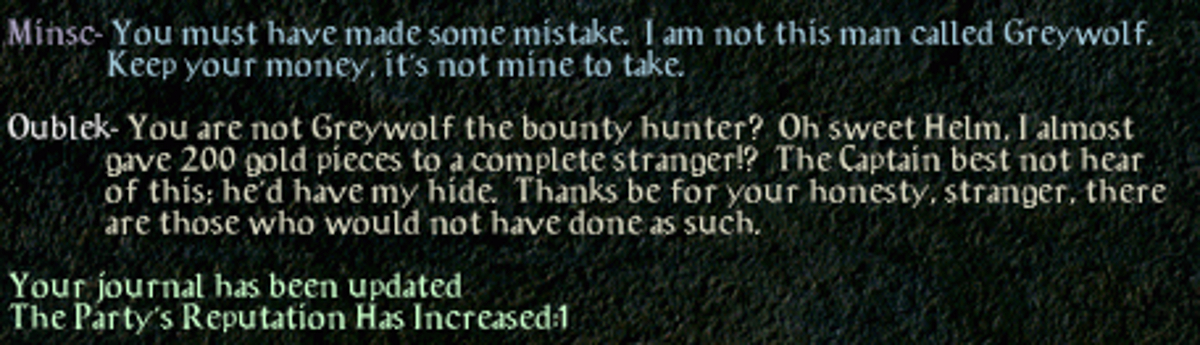
But if we're already clearly upstanding, no such option to dupe or be honest appears:

I like this. It shows that word has gotten around that Charame is an upstanding citizen. He or she is well-known and cannot be mistaken for a ruthless bounty hunter, which is what Greywolf is.
Lastly, we have Reaction-based reactivity as it pertains to how the authorities perceive us. While global and non-trivial, the ramifications of this one are rarely felt by reason of most people rolling with decent Charisma and decent reputation scores. Thus, the authorities just pass on by. However, if our Reaction plummets, we're in for it.
First, we receive the following message:

At this point things can get chaotic not just because the guards are coming but also because our upstanding companions are at breaking-point and leaving. Depending on the player's outlook and agenda, this can be utterly devastating or just part of the fun and laughter. That said, most players take this sort of thing very seriously and deem them both to be highly undersirable.
Anyway, what happens next is sort of random. We may be hunted down by a bounty hunter...

...who, however, can be paid off:

(That may hurt the back pocket, though!)
We may be attacked by Flaming Fist Enforcers...

... who cannot be paid off. We are simply charged with our crimes on the spot, and an attempt is made at slaying us on the spot (summary execution). This is global and won't stop until we make ammends.
|
| Bounty Hunter, Flaming Fist Enforcers, Amnish Soldiers |
And the same goes for the Amnish Soldiers in Nashkel, who will attack on-sight (above right pic).
It is possible to fight them all off or just run away. And where would be our next port of call? Well, we would likely bee-line to a temple for a little... philanthropic therapy.
In conclusion, if we have a decent reputation score along with a decent charisma score (or have access to a companion with decent Charisma), we'll be able to recruit any companion, win most rewards, and avoid clashes with the authorities. That is Reaction in a nutshell.
Overall, in retrospect, I think BioWare didn't employ enough reaction-based reactivity. For example, how we are are perceived by Ajantis, paladins such as Bjornin (a quest-giver), and by noble NPCs in general. Or how we are perceived by the forces of evil. Nor did BioWare make the checks tough enough in regard to rewards and companion recruitment. Still, it's a sound implementation overall (remember: 1998; a fledgling developer coding an engine and designing a campaign, side-by-side), and one which modders could certainly have expanded upon for the veterans, if there was demand. Which there hasn't been. So it's clear to me that BioWare did a good enough job in this respect.
Factional Rivalry Baldur's Gate [§4.0]

Companion-based Reactivity: Factional Rivalry
I've already covered companion-based reactivity in regards to reputation and reaction, but Companion-based reactivity also involves factions, personalities, game-time and plot progression. This post just covers factional rivalry.
In regard to companions, there are two factional rivalries in Baldur's Gate: the Harpers versus the Zhentarim and the Wychlaran versus the Red Wizard of Thay. Just as their factions are antagonistic to one another, these companions just don't get along at all. And when plonked into the same party, the results can be quite amusing.
Usually there are warning signs and "a build up" before any free-for-all ensues (solely voiceset and voiceset + text back-and-forths), but not always. Sometimes violence ensues within minutes of the mutually-exclusive being partied.
Let's begin with the Harper and Zhentarim duos respectively consisting of Jaheira/Khalid and Xzar/Montaron. First, we have the verbal warnings:
Now, the dialogue-based warning signs (which are fully voiced) are truncated versions of the breaking-point dialogues screen-capped below. Basically, just the two or three lines, semi-randomly picked providing they have a logical flow. From my tests, Khalid & Xzar can boil over as can Jaheira & Xzar and Khalid & Montaron, but not Jaheira & Montaron (probably just an oversight).
Let's begin with the Harper and Zhentarim duos respectively consisting of Jaheira/Khalid and Xzar/Montaron. First, we have the verbal warnings:
- You are amusing, in a "what the hell is wrong with you" kind of way. - Jaheira.
- Oh speak no more, lest ye gorge my sweet tooth! - Xzar.
- I don't want to seem c-confrontational, but could you be a little less . . . well . . . evil? - Khalid.
- Ye live longer if ye don't annoy me. Mayhaps even a week or more. - Montaron.


So! It's Harpers and Zhentarim duking it out! Who will win? It could go either way!
In this epic confrontation of the ages, Xzar casts Larloch's Minor Drain to gain the initial upper-hand.

In fact, he manages to knock Jaheira out with follow-up punches to the head!

However, Jaheira regains consciousness, gets back up, and whales away on Xzar's ribs with her quarterstaff. Having bludgeoned the mad wizard to death, Nature's Servant then turns around to help Khalid against Montaron, who has caused morale-failure in our most courageous stutterer. But Montaron is on his last legs, so in a final swing of her stick Jaheira purges the party of the Zhentarim.
 |
| Better part of valor! Better part of valor! |
Thus, the Harpers emerge victorious... this time.
Next up, we have the Wychlaran versus the Red Wizard of Thay. This pits Dynaheir and Minsc against Edwin, and is foreshadowed by the clashing quests of Minsc and Edwin covered in my retrospective (recap pic).


Of course, once partied, there are verbal hints as well:
• You travel with Minsc, you toe the line! I'll not suffer slackers while I'm busy hero-ing! - Minsc.
• Watch your words when addressing me, lest they be fed to you on the end of my boot! - Edwin.
And then, as per the Harpers and Zhentarim, there may be shorter dialogues culminating in the following final exchange:

The three leave the party, duke it out, and don't stop until the other side is dead. Charname looks on in bemusement but can intervene in order to affect the outcome. Once it's over, the victorious auto-return to the party, and we loot the corpse of the loser/s. Which is usually the outnumbered Edwin.
In addition to the Entillis Fullsom encounter covered the second section (which has some nice flavor dialogue if Jaheira has passed on), there are two other forms of factional reactivity that I can think of, off-hand. The first involves a potentially lethal encounter - involving no fewer than four Red Wizards - staged atop the ruins of the wilderness zone east of Larswood.

If we don't have Edwin in the party, they cannot be bargained with or reasoned with.

But with a Red Wizard in tow they'll have words for Edwin and then leave peacefully.

But with a Red Wizard in tow they'll have words for Edwin and then leave peacefully.

Quite the contrast.
The other example involves an encounter with Xzar's Zhentarim superior, Niemain, on the second floor of Sorcerous Sundries, in the city of Baldur's Gate.

Usually the convo goes like this, causing Niemain and three other Zhentish mages to attack:

Usually the convo goes like this, causing Niemain and three other Zhentish mages to attack:

And, while there is a peaceful solution independent of companions:

... it's a nice touch that, with Xzar or Montaron in the party, the aggro is avoided based on their presence. First:

If we inquire:

Inquiring without Xzar but with Monty still in-tow:

Of course, it is possible to learn of Xzar and Monty's faction long before this encounter. The rivalry with the Harpers is one way. Charming Xzar, another:

And we learn - as early as Chapter Three - that the Zhentarim would have reason to investigate false attribution:

Personality Clashes [§5.0]

As with factional rivalries, personality clashes are pre-coded and out of our control. No amount of reputation or reaction will keep companions in the party if they are coded to break ranks and duke it out. There are a few personality clashes or fundamental differences in companions that end in bloodshed, but some do not (possibly due to oversights), such as Kivan vs. Viconia, and Faldorn vs. Jaheira.
Let's take a look at three personality clashes that end in violence, shall we?
First up, we have the Noble Dwarf versus the Greedy Dwarf; namely, Yeslick versus Kagain. Yeslick, formerly of clan Orothiar, represents the classic Tolkien dwarf in that he wants to right wrongs and see poetic justice done.

Yeslick offers sage advice to the party during their adventure. He's one of the best companions for a Good party to have around. It's sort of a pity that we have to wait until Chapter Four to get him.
Kagain, on the other hand, runs a shady mercenary company that has been affected by the banditry plaguing the region. His goal in life is to become stinking rich, and he believes the only thing better than gold is more gold. He sounds pretty reasonable here, though:

But his audio-only stuff reveals his avarice:
- Do gooders always make me wanna vomit.
- Waiting around ain't gonna make us any money.
- I like it here, where the gold grows.
- Shaddup and show me the money.
- Altruistic moron!
This dwarven rivalry is amusing. I certainly had a laugh while writing this. Mainly because Yeslick keeps alluding to Kagain's greed and selfishness.

That third line in the above screencap repeats fairly often, sounds very funny to me, and it really pisses Kagain off:

This next one is the best exchange. It's also the last straw:

Only hammer and axe can settle this once and for all.
Second, we have Bard Eldoth going up against Grunt Shar-Teel. The former is the best trash-talker in the game, and he gets under the skin of many companions as a result, but getting under Shar-Teel's is a big no-no.

The build up continues:

And the culmination invariably results in an Eldoth "chunking":


Indeed.
Thirdly, Tiax and Quayle are both insufferable, but I'd say Quayle takes the cake.

Quayle is just so annoying and insipid:

And so Tiax snaps:

Thus, the two diminutives with the biggest egos ever seen on the Infinity Engine, go medieval on each other. It's very funny to watch this after hearing their carry-on for so long.
Ok, this next one is a little different:
Being a paladin, Ajantis doesn't like Evil-aligned companions:
His honor is his life, and he'll eventually unsheathe his sword for the glory of Helm:

The difference being that he and his target don't break out of the party. This means the player can simply select Ajantis and move him away in order to reset him. A pity.
Lastly, we have clashes and fundamental differences in companions that don't end in violence, either by design or due to oversight.
Xan and Ajantis certainly have their differences. This one is indirect in that Xan interjects when Ajantis complains about Evil party members:


Eldoth and Garrick bardic rivalry:


There is no way Garrick is Chaotic Neutral. He is far too reasonable and level-headed.
Eldoth is dismissive of Skie:


The elven rivalry that involves Viconia and Kivan does not end in bloodshed, but it seems that it could have:


It is also a pity that Yeslick and Kagain - who hate elves - don't fight with them (or any elven companion).
Technically factional but barely explored, the same is true for the Faldorn/Jaheira rivalry. Nature's Servant was raised by more tolerant Druids of the Tethyrian forest, whereas Faldorn is a fanatical Shadow Druid who rages against all who threaten the Great Mother:

On more than one occasion, she challenges Jaheira's more balanced beliefs:


She also tries to provoke Jaheira through Khalid: Jaheira, your choice of a mate suits your weakling nature. But in what is probably an oversight or lack of time in the dev cycle, Jaheira doesn't respond to any of this.
Note that the Shadow Druids of the Cloakwood forest do not attack the party if Faldorn is a member. This is the same as the Red Wizards not attacking if Edwin is a member.
Conclusion: Baldur's Gate banters are basic. As with Jagged Alliance 2, they don't spell everything out and explain everything. It is enough to hear the voices and read the text, to grow to love, hate or be indifferent to the companions. Everyone will have their favorites based on the minimal interactions and voicesets alone. I didn't like how Shadows of Amn and Throne of Bhaal handled banters: while some expansion of character is welcome (indeed, arguably needed), BioWare went way overboard and managed to make many of the companions tiresome, annoying and long-winded (the new ones and the old). Also, forcing a canon party on the player went against the spirit of the original Baldur's Gate. But I've already written about this in BG > BG2.
Coran and Safana:


(They get together in the sequel - both as non-party members - but it doesn't last.)
Return to:
Very enjoyable write-up, as always. I'm always torn between all these options, but the infiltration is probably the most fun for the additional dialogues. I also think that it's a bit of a shame that you can't do a bloodless infiltration run without sneaking.
ReplyDeleteThere's one small thing that is connected to the Bandit Camp - after Chapter 3 begins you can find Deke in the Coast Way location (South from Friendly Arm Inn) where the caravans are on the east. He will attack you with his group of bandits, but if you kill his buddies and spare him, he will start talking and begging for his life. He can give you the location of the Bandit Camp, but you won't able to infiltrate it with his help, as it is with Raiken or Teven. This way you can skip Tranzig as well. As far as I remember getting the location from Deke will cause both Raiken and Teven disappear for some reason, so it's rather the option for those that want to storm the Camp.